


Choosing guide for Promotional Badges & pins
Practical, versatile and easy to wear, promotional badges and pins help communicate messages, showcase a brand and make people and initiatives recognisable. The range of available models makes it possible to choose an accessory suited to each setting and intended use, while the materials affect its appearance, feel and durability. Size matters too, because it determines how visible an item is and how much room there is for artwork. Customisation gives these small promotional items their distinctive character: logos, names and messages can reflect the identity of companies, associations and promotional campaigns.
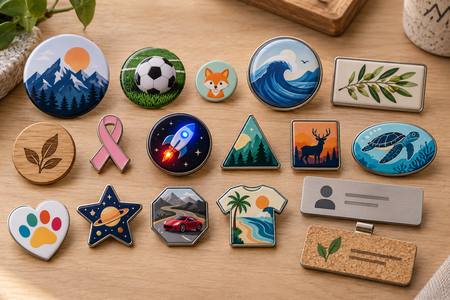
Available models
Promotional badges and pins come in several models, each with its own shape and features.
- Name badges: usually rectangular identification plates designed to show names, roles and symbols. They fasten with a pin, clip or magnet and make people easier to identify at courses and events.
- Button pins: a classic and widely used round model, suited to commemorating events or decorating backpacks, jackets and bags.
- Geometric pins: square, rectangular, oval or triangular models with defined outlines that highlight lettering, crests and illustrations.
- Shaped and fully customised pins: available in many outlines and able to depict objects, animals and symbols faithfully. Ideal for anniversaries, hobbies and themed initiatives.
- Magnetic pins: attach without piercing fabric, making them useful for delicate garments or items that need to be removed frequently. Depending on the model, the back can feature a magnet, magnetic fastening or sometimes a magnetic plate.
- Symbolic and multifunction pins: awareness ribbons and rosettes express support for a cause; LED designs, keyring models and bottle-opener versions add useful features for parties and special occasions.
All these products have one feature in common: the rear fastening system used to attach pins and badges to clothing and accessories. The most common option is a traditional safety pin that passes through the fabric and locks into place. Alternatives include a metal clip that grips a garment's edge and an alligator clip with small serrated jaws for a firmer hold. Some models have a pin-free fastening, while others may use a standard or press-stud button depending on the attachment required.
How to choose between different materials
Metal is among the most common materials for promotional pins and badges because it allows slim, sturdy and durable accessories. Metals include tinplate and aluminium: tinplate is often used for pins and combines durability with affordability, while aluminium provides rigidity without making the item heavy. Natural alternatives include wood and bamboo, valued for their natural look and smooth, grained surfaces. Other models are made of plastic or contain RPET components, a recycled material suited to initiatives focused on sustainability and reusing waste materials. Paper is mainly used for the printed insert in certain pins, carrying the artwork, logos and colours.
Sizes and dimensions
Pin sizes depend largely on their shape and model, and affect the space available for customisation. Round pins come in small sizes of approximately 18–30 mm in diameter, medium sizes of 44–58 mm and large versions reaching 100 mm. Square models generally have sides from 15 to 50 mm and remain compact. Oval and rectangular designs tend to be wider: smaller and medium products range from 26 × 14 mm to 65 × 45 mm, with others reaching 90 × 50 mm or 90 × 60 mm. Shaped pins vary according to the silhouette: stars, hearts and shields are generally 50–70 mm, while fully customised variants can offer up to 15 cm² of surface area. Identification badges are usually rectangular, sometimes with rounded corners, and generally measure 53–70 mm wide and 25–35 mm high.
Printing techniques
Customisation gives pins and badges colour and meaning, reproduces logos, pictures and messages and, on some models, even defines the product's shape. Not every technique works on every item: the choice depends on the material, the logo and the available print area. Digital printing is widely used for full-colour images, gradients and fine details; on pins, it often prints the paper insert fitted into the body. Epoxy resin can protect the graphic with a clear coating that creates a slightly raised, glossy effect. Digital transfer reproduces multicolour images using heat and pressure. Pad printing suits simple logos and wording, including on small or slightly uneven surfaces. For a traditional finish without inks, engraving is an option for compatible metals and natural materials such as wood and bamboo.

Gift ideas and suggestions for use
Promotional badges and pins are affordable, versatile and easy to distribute in high quantities because they are light and compact. At trade fairs and conferences, badges identify exhibitors, speakers and staff, while pins can be handed out to visitors or included in attendee packs alongside Personalised Pens and Personalised Keyrings. A similar distinction applies in shops, hotels and restaurants: badges display staff names and roles, while pins accompany openings and promotions. In associations and foundations, recognisable colours and symbols are used for awareness campaigns, fundraising and charity initiatives. Sport, culture and entertainment also offer many opportunities. Pins make much-appreciated small souvenirs featuring mascots and crests, or historical figures, landmarks and memorable experiences. In companies and training centres, badges distinguish tutors, trainees and staff, while pins can mark anniversaries and group activities or go into corporate gift boxes alongside Personalised Water bottles & Sport bottles, Personalised Mugs and Personalised USB flash drives.
If you need more information or a practical checklist to help you choose the Promotional Badges & pins best suited to your needs, download this document.
Promotional Badges & pins - FREQUENT QUESTIONS
It depends on the occasion and the artwork you want to feature. Round button pins work well for straightforward graphics, event souvenirs and large distributions. Geometric pins highlight logos and lettering with defined proportions. Shaped or fully customised pins are best when the outline itself matters, such as for tourism, a sports team or a museum.
For round or compact logos, choose button pins; for square, rectangular or elongated logos, geometric pins retain the original proportions. If a symbol has a recognisable outline, such as a shield or mascot, shaped pins can follow its silhouette. Name badges are preferable when a logo must appear alongside the wearer's name and role, for example in hotels, shops or at trade fairs.
Consider the fabric and how frequently the item will be used. Safety pins and metal clips attach well to garments, backpacks and cases; serrated clips grip straps or lanyards without piercing the material, making them practical on bags. Magnetic fastenings make attaching and removing pins quick and easy. Bear in mind that not every fastening is offered for every model.
It depends on who will wear it and where. In shops and hotels, a name, role and logo may be enough. At trade fairs, the company and function help distinguish exhibitors and organisers. At conferences, add the speaker's name, organisation and title. Keep information concise, with legible lettering and strong contrast so it can be read at a glance.
For handing out large numbers at trade fairs or campaigns, button pins with full-colour artwork are a practical choice, especially in medium sizes. To identify exhibitors, volunteers or staff, choose name badges with legible text and suitable fastenings. Shaped pins and special finishes can make a symbol or occasion stand out. Awareness ribbons and rosettes are a good alternative for charity initiatives.
With name badges, the priority is being able to read names and roles; with pins, size depends on the artwork. Small or medium round, square and rectangular pins can work for simple symbols and messages. For more visual impact, consider triangular, oval, shaped or fully customised designs. Always check the actual printable area, which may be smaller than the overall dimensions.
Yes, depending on the model. Some product pages allow you to choose different sizes and formats within the same range before purchasing. This helps maintain a consistent look across different shapes and dimensions.
They are included on some models. Where the process is included, you may only need to pay the print setup charge. Otherwise, the relevant cost will be shown during checkout.
It depends on the intended setting. Gold and silver give a metallic look suited to anniversaries and company awards. Glitter and relief effects enhance decorative pins and souvenirs. Glow-in-the-dark and reflective finishes have different visual functions: one can shine in darkness, while the other reflects incoming light. Fabric- or leather-effect surfaces offer a textured finish. Check availability on each product page.
It varies by model. Minimum orders are often 100 pieces, although certain items require 300. Some models also allow you to buy a sample so you can assess the dimensions, finish and fastening in person. The conditions are listed on the individual product pages.