


Choosing guide for Custom Glasses cases
Custom Glasses cases help store and carry prescription glasses and sunglasses, protecting them against dust, scratches and contact with other objects. Available models differ in their openings and closures as well as their materials. Material determines texture, flexibility and the level of protection, while shape and dimensions help you find a suitable case for different needs and eyewear. Adding logos, lettering or graphics also turns these everyday accessories into promotional products that increase brand visibility and recognition.
Models and accessories
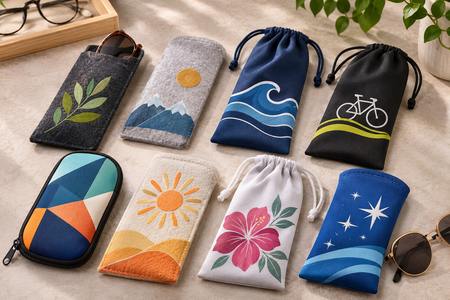
There are two main types of personalised glasses cases, with different closures and features. Soft cases are lightweight and flexible, so they fit easily into bags and backpacks. Some have a simple open top, while others feature a zip to prevent glasses from slipping out accidentally; they mainly protect against dust and rubbing. Drawstring pouches close by pulling a cord that tightens the opening. They take up little space and can be folded when not in use. Several practical accessories can also be paired with glasses cases. The classic choice is a microfibre cleaning cloth, which removes fingerprints and marks from lenses. Glasses straps keep eyewear around the neck, while cleaning and maintenance kits contain small tools for caring for glasses.
Materials
Texture, flexibility, durability and appearance all depend on the materials used. Polyester is widely used for personalised glasses cases because it is lightweight, wear-resistant and easy to clean. Alongside conventional polyester, there is recycled polyester and blends such as softshell, which is stretchy and more structured thanks to a small proportion of elastane. RPET felt offers a compact surface that feels soft to the touch. Other choices include non-woven fabric, a light, thin material made without traditional thread weaving, and RPET neoprene, which is thicker and helps cushion minor knocks. Microfibre is an especially fine, soft fabric also used for lens-cleaning cloths.
Shapes and sizes
The shape of these accessories naturally follows that of glasses, so most cases are rectangular and wider than they are tall. Sizes vary depending on the model and closure, but soft cases are generally 15–18 cm long and 7–10 cm high. Drawstring pouches have a similar outline but tend to be longer, often measuring around 9 × 20 cm.
Printing techniques
Customisation makes it possible to adapt promotional products to a particular occasion, event or recipient. Logos and lettering can be applied using different printing techniques, depending on the material, the artwork and the available print area. Digital transfer and transfer printing are common on personalised glasses cases: both use heat and pressure to apply graphics to the product surface. Digital transfer reproduces detailed images, gradients and multiple colours, while standard transfer is especially suitable for logos and designs with clear outlines. Sublimation printing can produce sharp, vivid, photographic-quality results, but it is only suitable for polyester or specially prepared surfaces, generally in light colours. For simple logos with a few solid colours, consider screen printing or pad printing.
Gift ideas and suggestions for use
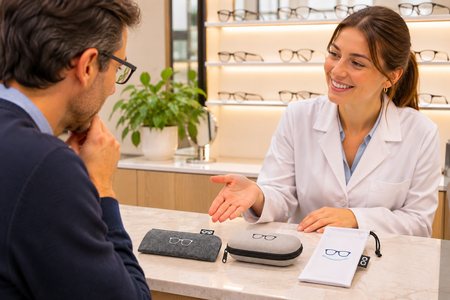
Personalised glasses cases are useful everyday accessories, whether travelling and commuting or at home and in the office. Opticians often give them to customers with newly purchased glasses, sometimes adding a lens-cleaning cloth. They are also a practical choice for hotels and beach clubs, especially as summer approaches. Together with products from the Personalised Beach towels and Personalised Fans categories, they help create a useful kit for days by the sea or pool. The same applies to campsites, tour operators and travel agencies. Combined with products from the Promotional Sunglasses category, they provide a reminder of the experience and can be reused on holidays and organised trips. Businesses can also distribute cases and pouches at events, trade fairs and conferences, particularly those focused on optics, reading or eye health.
If you would like further guidance or a practical checklist to help you choose the most suitable personalised glasses cases, download this document.
Custom Glasses cases - FREQUENT QUESTIONS
It depends on how they will be used. Soft cases are preferable when glasses are stored and taken out frequently, for example when an optician includes one with a purchase. Zipped cases offer a more secure closure when travelling. For trade fairs and competitions with large numbers of participants, drawstring pouches are practical because they are easy to hand out and take up little room.
A microfibre cloth is useful for everyday lens cleaning, for example as an optician's complimentary gift. A glasses strap suits people who frequently remove their glasses while hiking or playing sport, keeping them close at hand. A kit with a cleaning cloth is better suited to after-sales service when you also want to provide a small tool for maintaining frames.
For fairs, conferences and events with many attendees, consider non-woven drawstring pouches or basic soft cases: they are lightweight, easy to distribute and relatively inexpensive. For a smaller audience, RPET felt can offer a more refined presentation. Consider maintenance kits or zipped cases when you want to offer a gift with higher perceived value.
Hotels can use compact soft cases in welcome kits; guests can reuse them when travelling. At beach clubs, drawstring pouches fit neatly into a beach bag and help protect glasses from sand, but they are not necessarily waterproof. For corporate gifts, RPET felt models highlight recycled material, while zipped cases suit employees who travel often and need a more secure closure.
It depends on the product. Common positions include the front, back and, where the printing technique allows, the entire surface. Products with boxes, cloths or accessories may offer additional branding options. Not every position is available on every item: check “Printing information” on the product page for printable sides, methods and area dimensions.
Yes, provided the model comes in several colours. The product page shows the available variants and the quantity in stock for each. Remember that overall availability does not guarantee stock in every colour. A mixed-colour order can distinguish kits for different company departments, identify groups at an event or offer shop customers a choice, while keeping the model and customisation consistent.
Start with logo legibility: dark artwork usually stands out on a light background and vice versa. If your brand design contains gradients or many colours, also check which printing methods are available for the model. For hotels and corporate kits you can match your brand palette; for outdoor distribution, a shade that makes everyday marks less obvious may be practical. Check available colours and request the free artwork proof before ordering.
Yes, you can for most personalised glasses cases in the catalogue. Where this option is offered, simply click “BUY SAMPLE” and complete your purchase. A sample is useful before placing a large order, as it lets you assess the product and its features in person.