


Choosing guide for Personalised Fans
Personalised Fans are simple, practical accessories for keeping cool on hot days, while travelling, at ceremonies and during outdoor activities. The range of designs and materials makes a difference to their structure, weight, durability and ease of transport. These features help you choose the most suitable product for your needs and open up possibilities for everyday use as well as special occasions. Different customisation techniques also make it possible to add logos, lettering and artwork, giving each fan a distinctive appearance and helping your brand stand out.
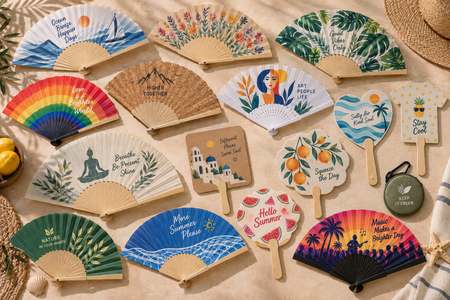
Available fan styles
One of the main differences between personalised fans is their construction and how they are stored. Rigid models keep their shape and are ready to use straight away; foldable models fold down to take up less room, while traditional folding fans open into a semicircle as their ribs spread apart. Beyond this distinction, there are three main types. Classic folding fans consist of ribs joined at the base and a flexible leaf that stretches out when opened. Light and easy to slip into a bag, they suit everyday use and ceremonies. Pai pai fans have a flat surface supported by a handle, making them easy to hold and providing a generous print area. They may be geometric, such as round, oval or rectangular, or die-cut into shapes such as houses, trees, hearts and T-shirts. Finally, fans with accessories build on these designs with lanyards, carabiners, sleeves or decorative details to make them easier to carry, keep close to hand or enhance their appearance.
Materials and construction
Personalised fans are made from different materials, often combined in a single product. To understand their properties, it helps to distinguish the three main components: the frame and ribs, the handle where present, and the fan leaf, or the surface that moves the air. Frames and ribs may be made from wood, valued for its sturdy, natural appearance, or bamboo, appreciated for its lightness and flexibility. Other options include RPET, made from recycled material, and plastics such as ABS, PP and PS, usually economical and available with varying degrees of stiffness and durability. Handles use similar materials, while the leaf offers a wider selection. Polyester is the most common: light, hard-wearing and also available in recycled versions. Paper comes in several forms. Kraft paper, card and recycled cardboard offer different degrees of thickness and rigidity, while plantable seed paper is an unusual option for environmental events and initiatives. Some fans have a body made from wood, which is firmer and more rigid, or cork, with its distinctive natural texture.
Everyday and sports uses
The main purpose of personalised fans is to move air, helping people cool down and feel more comfortable in hot weather, especially in summer. In sport, they can be used during breaks in outdoor activities such as tennis, padel, beach volleyball and athletics, as well as by spectators watching matches, training sessions and competitions in the sun. Their light weight and portability also make them useful on hikes, walks and breaks in nature, particularly when the air is still. Beaches and swimming pools are another natural setting, where a fan can provide some relief from the heat while relaxing on a lounger or beneath a parasol. In daily life, they are handy in crowded or poorly ventilated places such as public transport, ceremonies and nightclubs.
Printing techniques
Customisation is what makes fans and other promotional products unique and recognisable. Each technique produces a different result, but its suitability depends mainly on the material, the logo and the available print area. The technique most commonly offered for personalised fans is pad printing, suitable for relatively simple logos and for small or slightly curved surfaces. Screen printing can be an equally economical alternative, especially for larger quantities, and works well for uncomplicated artwork using a few solid colours. Engraving is also widely used, particularly on wooden or bamboo ribs and handles, producing a precise, durable mark without adding ink. Digital options include digital printing, which can reproduce photographs, details and gradients in full colour directly on the surface, and digital transfer, which uses heat and pressure to apply multicolour artwork and is particularly suitable for textile surfaces.
Gift ideas and settings
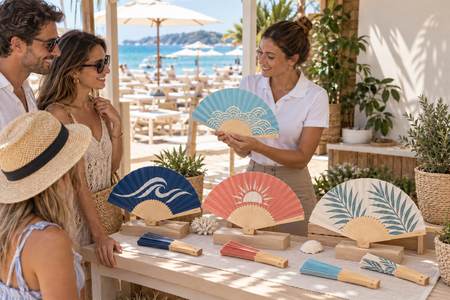
Personalised fans are practical, versatile items, especially useful in crowded settings, during summer and on hot days. Their earliest uses date back to 17th-century Japan, but they remain a portable alternative for anyone needing to cool down when air conditioning or electric fans are not available. Hotels, resorts and holiday villages can provide them for guests alongside products from the Personalised Beach towels and Personalised Slippers ranges, as can swimming pools and beach clubs. A particularly hot, humid day can also occur in the mountains, not only at the seaside. This makes fans useful for campsites, mountain refuges, event organisers and tour operators. Their practicality also suits indoor or crowded venues. They are often handed out at festivals, ceremonies and nightclubs with items from the Personalised Silicone wristbands and Promotional Sunglasses ranges, giving participants both a useful promotional product and a fashionable accessory suited to the occasion.
For more detail, or for a practical checklist to help you choose the most suitable personalised fans, download this document.
Personalised Fans - FREQUENT QUESTIONS
It depends on how they will be used. Foldable models take up little space and are easy to carry in bags and backpacks on hikes and walks. Rigid fans do not need opening and can be handed out quickly at concerts, festivals and trade fairs.
The choice depends on the style you want to achieve and the space needed for your artwork. Classic fans with ribs have a traditional semicircular shape and suit, for instance, resort gifts or lifestyle brands. Pai pai fans generally have a flat surface that helps messages and logos stand out at festivals, trade fairs or information campaigns.
Unusual shapes, such as hearts, houses or ovals, are useful when the outline reinforces the message: an estate agency could choose a house, or a wedding organiser a heart. Fans with accessories, such as a lanyard or carabiner, meet a practical need by making them easier to carry at festivals, guided tours, excursions and tournaments.
If you need to distribute large quantities, favour simple, lightweight models with a surface that shows off the branding. Paper or card pai pai fans work well at fairs and festivals; classic folding fans suit guest packs and more considered gifts. Choose shaped models if they match the event or artwork.
For guests who will use their fan repeatedly, consider polyester or RPET leaves with plastic, wood or bamboo frames. Paper and card are practical for seasonal promotions and occasional distribution but are more sensitive to moisture. For a beach club, prioritise ease of drying and resistance to sand and salt air.
Yes, this option is available in most cases. Open the product page, click BUY SAMPLE and complete the purchase. A sample is particularly useful before a large order, allowing you to check the product's durability, practicality and appearance in person.
Yes, you can. If the model is available in several colours, select the ones you want and the quantities you need, subject to stock. This is useful when creating a varied assortment to suit different combinations. However, not every fan offers this choice: some come only in natural shades, a single colour or a fixed pattern.
Start with the contrast against your logo: dark artwork shows up on light surfaces, while a dark fan may require a light-coloured print. Sports clubs can use their team colours; resorts can match their own colour palette. For photos or gradients, first check which models support full-colour printing. Review available colours, print area and printing technique; for substantial orders, a sample helps assess the actual result.
It depends on the model. Depending on the item, folding fans may allow printing on the front or back of ribs or handles, and some offer additional areas on the fabric. On pai pai and shaped fans, artwork may cover the front and back surfaces and sometimes the handle. Certain products also allow boxes or sleeves to be customised. Check the print positions listed on the product page: not every position is available on every fan.
It depends on the characteristics of your logo, the individual product and your budget. Pad printing is particularly economical for simple logos with one or a few colours, such as a sponsor's mark on tournament fans. Where available, engraving produces an understated result without adding colour and complements wood and bamboo. For photographs, gradients or extensive artwork, select a fan that supports full-colour digital printing.