


Choosing guide for Personalised Tea boxes
Personalised Tea boxes can be used to offer customers and guests a drink, whether at events or as a corporate gift. The available formats and quantities make it possible to choose the best option for the intended use, while the various flavours help cater to different preferences. Packaging also plays an important role: it protects the contents and determines how they are presented. Customisation then allows you to add logos, wording and artwork, adapting the product's appearance to the company's identity or the occasion for which it has been chosen.
Formats and quantities
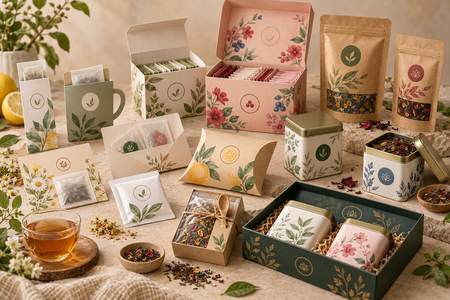
The first distinction to make concerns how the tea is supplied. The two main options are pre-portioned tea bags, ready to brew a cup, and loose-leaf tea, which can be measured out as needed. Tea bags come in small quantities, either double packs or single servings, as well as in boxes. These generally contain 12 or 20 tea bags, allowing several servings to be offered on one occasion. Loose-leaf tea, meanwhile, is mainly available in pouches and tins, so the desired amount can be taken out each time. A middle ground is offered by carton packs, available in different sizes and designed to hold either loose-leaf tea or an assortment of tea bags.
Flavours and aromas
Some people prefer tea with a strong flavour, while others enjoy delicate, citrus or fruit blends. Understanding these differences helps you select an appropriate flavour for the audience and occasion. The two main varieties are black tea and green tea. Black tea has a robust, full-bodied flavour: among its most popular variations is Earl Grey, flavoured with bergamot and also available with orange peel or small heart-shaped sugar pieces. Green tea has a more delicate taste with vegetal notes. Alongside the classic variety, there are lemon blends and combinations featuring orange, pineapple, sunflower petals and calendula, adding citrus and floral notes. Those looking for something beyond traditional flavours can choose forest fruit blends, featuring ingredients such as raspberry, hibiscus and elderberry, for a fruity, slightly tart taste. Winter forest fruit variations are also available and are particularly suitable for seasonal occasions.
Packaging
Packaging protects tea, makes it easier to serve and influences its presentation. Single and double packs contain one or two tea bags respectively, protected by food-grade paper and, depending on the model, accompanied by a card or wrapped in white or kraft paper. Boxes provide a more structured option: also made from paper or cardboard, they come in compact sizes of around 8 × 8 × 7 cm and wider, flatter versions measuring 17 × 19 × 3 cm. Cylindrical tins, meanwhile, are made of metal, protect the tea from light and measure approximately 8–12 cm in diameter and 12–14 cm in height. Loose-leaf tea can also be supplied in paper carton packs and kraft pouches. The former are usually cube-shaped or pillow-shaped, sometimes with small front windows; the latter are lighter than rigid containers and have a flexible, upright construction.
Customisation
Printing techniques allow logos, text and artwork associated with a company or occasion to be applied to promotional products. However, no one method works for every item: the material, the characteristics of the logo and the available print area all matter. For personalised tea packaging, the most widespread method is digital printing, which reproduces images, gradients and full-colour designs directly on the product, giving plenty of creative freedom. Other options include full-colour adhesive labels, where the design is printed on a label and then applied to the packaging, and flexographic printing, which transfers ink to the material using a flexible printing plate. Flexography is versatile and can reproduce complex designs fairly quickly, but it is generally available only for relatively large orders. Less commonly, pad printing is used for simple logos with few colours on small print areas.
Gift ideas and suggested uses
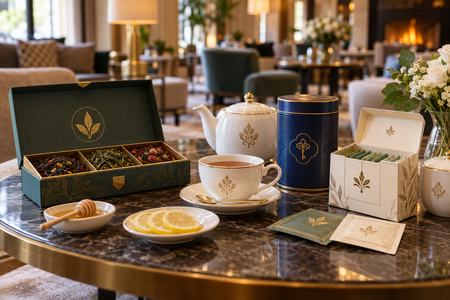
Tea is one of the world's most widely consumed drinks, valued for its range of flavours and the ease with which it can be prepared and served. It accompanies different moments throughout the day and fits many professional settings. Hotels and B&Bs, for example, often provide tea-making facilities in guest rooms and shared breakfast or refreshment areas. Bars and restaurants may serve it after meals in Personalised Mugs, alongside Personalised Biscuits. Catering services can offer it with Personalised Chocolates and Custom Sweets during breaks at meetings and corporate gatherings. At trade fairs and conferences, personalised tea boxes are often given to customers and visitors, while spas and wellness centres may serve tea after treatments or include it in small gift sets. During festive periods and corporate celebrations, personalised tea boxes can also make a welcome gift for employees, suppliers and business partners.
If you need more detailed information or a practical checklist to help you choose the most suitable personalised tea boxes, download this document.
Personalised Tea boxes - FREQUENT QUESTIONS
It depends on who will receive the gift and how it will be used. Tea bags are more practical when tea needs to be prepared quickly in consistent portions, for example in hotel rooms or at conferences. Loose-leaf tea is better suited to tasting rooms, spas and carefully chosen corporate gifts, where the blend and preparation matter. If the recipient does not have a tea infuser, a single-serving pack is a better choice.
Single-serving packs are suitable for individual distribution and occasional consumption: trade fair stands, welcome kits and small gifts included with orders. Boxes of 12 tea bags work well as small customer gifts or for longer stays; boxes of 20 are useful for meeting rooms, offices and refreshment areas where several servings are needed in the same place. Before choosing, consider how many people will use the box and how often.
Choose according to the intended use. A 40 g kraft pouch is a simple option for small gifts aimed at loose-leaf tea enthusiasts. A personalised carton pack provides more room for artwork and suits welcome kits and special campaigns. Boxes containing 12 or 20 tea bags make repeat use easier. Consider boxed loose-leaf tea or tins for corporate gifts or when you want a more refined product with a higher perceived value.
For an assortment intended for many guests, combine Earl Grey and green tea to offer two traditional flavour profiles. Hotels and restaurants can add lemon green tea and a forest fruit blend to broaden the choice. For more distinctive corporate gifts, consider unusual flavours and fruit blends too.
For trade fairs and conferences with large audiences, choose individual Earl Grey or lemon green tea bags: they are easy to use and distribute. Double packs or boxes of 12 tea bags work better for smaller meetings with clients or partners. For an end-of-event gift, consider carton packs and tins of loose-leaf tea with aromatic or forest fruit blends.
It depends on the product selected. Minimum quantities generally range from 50 to 2,000 units. A threshold of 100 is the most common and, in some cases, a trial sample is also available. Where offered, simply click “BUY SAMPLE” and complete your purchase.
Available positions depend on the packaging and format. Tea bags, pouches and tins can generally be personalised on the front and back, while carton packs and boxes may also allow printing over the entire outer surface.
Yes, generally they do. The minimum guaranteed shelf life is usually 12 months and is stated on the relevant product pages. When you receive your order, remember to check this information carefully.