


Guide to choosing Personalised Coffee boxes
Personalised Coffee boxes are a classic, versatile choice for tastings, events and gifts for customers, guests and colleagues. Different sizes, capacities and aromas help you accommodate tastes and coffee-drinking habits, while the packaging affects both presentation and protection of the contents. Customisation adds logos, lettering and artwork to make your brand more visible and recognisable.
Available formats
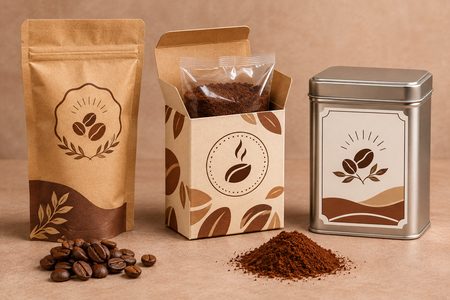
Personalised Coffee boxes mainly come in three formats, differing in shape and capacity. The rectangular paper boxes, wider than they are tall and relatively slim, are offered in two sizes: a small 25 g version and a medium 50 g version, both containing ground coffee. The pouches also have a rectangular shape but are taller and hold 40 g of coffee beans. The largest format is the 100 g tin, described as cylindrical and designed for ground coffee.
Flavours and aromas
The two main coffee options here are 100% Arabica ground coffee and roasted Costa Rican coffee beans. In the first case, Arabica identifies the botanical species, while in the second the precise geographical origin of the beans is given. The most important difference, however, is preparation. Ground coffee is ready to measure out and use, whereas whole beans must be ground first, allowing you to adjust the grind to your coffee maker or machine. Both offer a bitter, intense and aromatic taste, ideal alongside Personalised Biscuits and Custom Sweets during everyday breaks and relaxing moments.
Packaging
Packaging matters for coffee, as it helps preserve the product, makes transport easier and affects how it is presented. The paper boxes, available in white or kraft finishes, contain a transparent, recyclable food-safe pouch. Dimensions depend on capacity: the smaller box measures approximately 12 × 4 × 9 cm, while the medium version measures 14 × 4 × 10 cm. The kraft paper pouch is taller and narrower, at approximately 9 × 18 × 4 cm. The final option is a tin container, also holding a transparent, recyclable food-safe pouch; it is compact and measures 7.5 × 7.5 × 13.7 cm.
Printing techniques
Customisation is central to promotional products: it connects the item with the brand and improves its visibility and recognition. Not every printing method works on every product; the surface material, the logo and the available print area all determine the choice. Digital printing is common for Personalised Coffee boxes, reproducing multicolour images and graphics with good quality and durability. Two alternatives are full-colour stickers and pad printing. A sticker is printed separately and applied to the product, while pad printing is versatile and economical, especially for simple logos with a few solid colours.
Gift ideas and suggestions for use
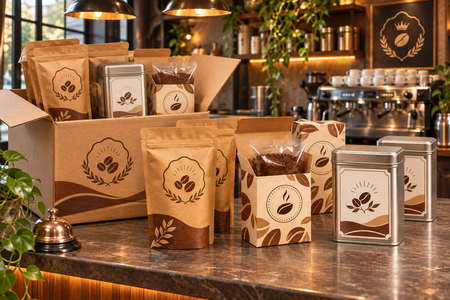
Coffee is one of the world’s most widely consumed and appreciated drinks, which makes these products suitable for many personal and professional occasions. Hotels and B&Bs often place coffee packs in guest rooms, welcome kits and breakfast areas. Bars, cafés and coffee roasters can pair them with Personalised Mugs and Printed promotional Espresso cups for openings, events and everyday service. At trade fairs and conferences, coffee stands and shops can use them for tastings and visitor giveaways. In companies, offices and professional practices, they can be gifts for clients and business partners or an added service for employees and staff.
If you would like more detail or a practical checklist to help choose the most suitable Personalised Coffee boxes, download this document.
Personalised Coffee boxes - FREQUENT QUESTIONS
Start with the type of gift and how many people will receive it. The 25 g packs work well for welcome kits and small tastings, while 50 g packs make a more substantial gift. The 40 g kraft pouches contain beans and suit recipients who can grind coffee. The 100 g tins have a higher perceived value and can be reused once empty. For large-scale distribution, also consider size and unit cost.
It depends on the intended use. Paper boxes are helpful when you want more room for artwork or to include coffee in a gift set. A lightweight, compact kraft pouch is convenient for counter giveaways or events. A tin offers a more structured presentation and can be reused. A compact option may be better for a conference, while a tin may be more suitable for a gift to selected customers.
Choose according to your audience. Ground coffee is practical for larger distributions because it is ready to prepare without further processing. Whole beans, on the other hand, retain their aromatic characteristics for longer and let recipients choose the grind size. Ground coffee is therefore suitable for hotels, offices and welcome kits, while whole beans lend themselves to tastings, coffee-roaster initiatives and gifts for coffee enthusiasts.
It depends on your artwork and the appearance you want. If your logo includes fine details or light colours, a white paper box provides a more neutral base. Kraft suits a simple, natural look, but its brown background can affect how colours appear. Tin is more rigid and reusable, with a traditional style; it is generally a good choice for full-colour printed labels.
For hotels and B&Bs, choose compact packs of ground coffee: they are practical and easy to use. Bars and coffee roasters may also choose more elegant formats and whole beans to offer a more distinctive product with higher perceived value. Restaurants and caterers can consider small gifts for private or corporate events.
When handing out hundreds of gifts, favour compact packs that are easy to carry and contain ground coffee. Not everyone has a coffee grinder, so ground coffee is immediately usable. Consider tins or whole beans if you prefer reusable packaging or a product with higher perceived value.
It depends on the chosen format. Pouches can generally be customised on the front, just above the label with the coffee details. Tins and paper boxes may offer a larger surface. To confirm the exact position, dimensions and printing technique, open the selected product page and select ‘Printing info’.
It varies by product. The standard minimum usually ranges from 50 to 200 pieces, although some products also allow you to order a sample. Check the individual product page for these details.