


Guide to choosing Personalised Chewing gum
Personalised Chewing gum makes a small, versatile gift that is easy to hand out at events, during promotional activities and in shops. Flavour shapes the experience of chewing gum, while the available formats and models offer a range of options in terms of quantity and packaging. Materials also play an important role: they protect and preserve the contents while determining how the pack looks and how practical it is to use. Customisation allows you to add logos, wording and company colours, turning an everyday product into a distinctive, engaging promotional item.
Models and packaging
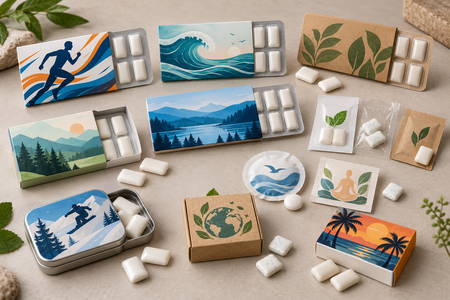
Personalised Chewing gum comes in several options, although most products share a mint flavour, appreciated for its fresh aroma and pleasant aftertaste. The main difference between models is the packaging, which varies in structure, capacity and ease of use. Small boxes contain several pieces of gum in a single compact, portable pack, while blister packs hold between 5 and 12 pieces in separate compartments. This makes it easy to take out one piece at a time; the blister often comes with an outer sleeve or band. Sachets are the simplest, lightest option. Single-serve sachets contain one piece of gum, while multi-piece versions remain small but can hold up to three pieces.
Packaging materials
When discussing the materials used for Personalised Chewing gum, the focus is mainly on the packaging, which protects the product and gives it its appearance. Several options are available, with paper being one of the main choices. White paper offers an even surface that works well for logos and colours, while kraft paper, with its characteristic brown shade, gives a more natural look. Other options include ecru paper with grass fibres, with its distinctive finish, and sturdier cardboard, especially for sleeves and bands. Some paper packs also have an inner food-safe film to help protect and preserve the gum. Other materials include plastic, often used for blisters and sachets, and metal tin, which makes it possible to produce sturdy, durable little boxes that can be reused once the gum has been consumed.
Formats and sizes
Personalised Chewing gum may resemble small, rounded dragées, or come as thin, rectangular sticks. Packaging formats depend on their structure and measurements. Blister packs are generally square or rectangular, ranging from around 5 cm to as much as 15 cm for longer versions. Small boxes, by contrast, are mostly round and seldom exceed 5 cm in either height or width. Sachets are very small and almost always rectangular.
Printing techniques
In this category, customisation is applied to the packaging rather than directly to the gum. Several printing techniques can be used, but they are not available for every model: compatibility depends on factors such as material, the characteristics of the logo and the actual print area. The most widely used option for Personalised Chewing gum is digital printing, which reproduces highly detailed, full-colour graphics. Flexographic printing can also provide high-quality full-colour results, but it is generally offered only for very large minimum order quantities. If you prefer an option that does not print directly onto the pack, consider a full-colour adhesive label: the label is printed and then applied to the item.
Gift ideas and suggestions for use
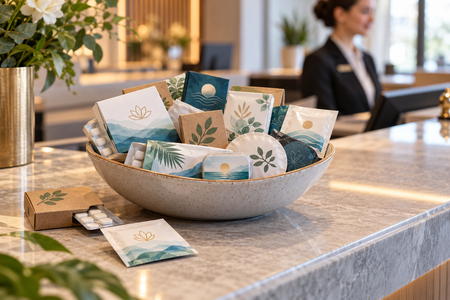
The practice of chewing gum-like substances goes back to ancient times and continues today, making Personalised Chewing gum a suitable gift for many promotional settings. At trade fairs and conferences, companies can hand it out alongside Personalised Keyrings and Personalised Lanyards. Hotels and other accommodation providers can place it at reception desks or in meeting rooms as a small welcome gift. Shops and online retailers can add a pack to purchases or outgoing parcels, perhaps during a promotion or product launch. This practical item is also useful for travel agencies, tour operators and transport providers, which can offer customers and passengers a simple way to freshen their breath during trips, outings and excursions.
If you need more detail or a practical checklist to help you select the most suitable Personalised Chewing gum, download this document.
Personalised Chewing gum - FREQUENT QUESTIONS
Decide according to how you plan to use it. For handing out large quantities quickly, choose single-serve sachets: they are light and easy to distribute, for example as people leave an event. Blister packs are better suited to welcome bags, since they allow several uses and keep each piece separate. Small boxes are ideal for a more considered gift, such as something to offer a visiting customer; metal tins can also be reused.
It depends on the features you need. White paper works well for multicoloured logos and intricate graphics. Kraft and ecru paper give a more understated image, such as for a farmhouse hotel or a natural-products brand, although print contrast needs checking. Plastic is used in sachets and blister compartments; the sturdier metal tin is suitable for gifts intended to last beyond the consumption of the gum.
Dragées are small and compact, have a more refined appearance and are convenient when you want to take one piece at a time, for example at a conference. Thin, elongated sticks may be preferable when a flat pack is required, such as for travel kits.
For busy trade fairs or stand giveaways, choose either single-serve sachets, which are easy to distribute, or classic, compact six-piece blister packs. Consider metal tins and blister packs containing 10 or 12 pieces when you want to offer a gift with a higher perceived value.
For hotels, a blister pack with 5 to 12 pieces can be added to a welcome kit, while a small box is better suited to a premium gift. In shops, single-serve sachets can accompany purchases at the till or online orders. For organised tours, transfers and car rentals, choose pocket-sized blister packs that protect the gum and are easy to hand to travellers.
It depends on the model. The front and back are usually the most common positions, but some products also allow customisation of the lid or the entire outside surface. For exact details, open the relevant product page and select ‘Printing info’.
It varies by product. Minimum quantities start at 100 packs for some blister products and rise to 250, 500 or 1,000 for similar items. For sachets and single-serve packs, the minimum can sometimes reach 2,000 or 5,000 pieces.
Start with your brand colours and the contrast with the packaging. White enhances multicoloured logos, while simple, clearly legible graphics work best on kraft paper. For transparent sachets, also consider the colour of the visible contents. Before ordering, always check the print area, dimensions and available techniques.