


Guide to choosing Custom Musical instruments
Custom Musical instruments offer an enjoyable way to explore music, experiment with sound and make parties and leisure activities more engaging. Available models differ in how they are used and in their functions. This variety suits people who simply want to play an instrument or let others try it, as well as those who need to play back or manage audio content. Adding a logo or wording turns each item into a promotional gift that connects brands and events with the world of music.
Available models
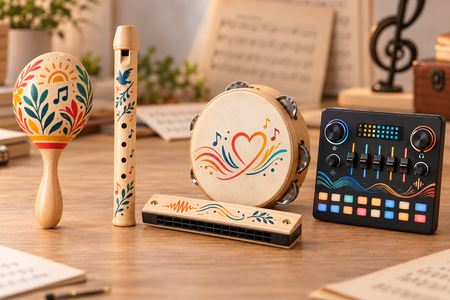
Custom Musical instruments vary in shape, construction and how they are played, offering different possibilities depending on the need and occasion. From traditional instruments to more technologically advanced devices, each has features that determine how it works and the experience it provides.
- Mouth harmonicas: small and easy to handle, with a long body and a row of holes through which air is blown and drawn. They come in different materials and finishes.
- Recorders and flutes: tubular instruments with a mouthpiece and finger holes that are covered while playing. Some models can be taken apart.
- Tambourines: round handheld instruments with small metal jingles around the edge. They can be shaken or tapped by hand.
- Maracas: instruments with a handle and a hollow body containing small loose elements; they produce sound when shaken.
- Audio mixers: electronic equipment used to adjust several sound sources, featuring controls, faders and knobs.
- Portable record players: devices for playing vinyl records, with a rotating platter and a tonearm fitted with a stylus. Some are housed in portable carrying cases.
Compatibility and use
For Custom Musical instruments, compatibility is important because it determines how products can be used and connected to other devices or media. The two main connection options are Bluetooth, which allows compatible devices to communicate wirelessly, and USB, which can transfer data or supply power through a physical connection. Record players must also be compatible with the relevant vinyl formats. Acoustic wind and percussion instruments, on the other hand, require no external connection: they can be played directly.
Audio functions
Every instrument offers a different sound experience. Some produce notes and rhythms directly; others play recordings or process multiple audio sources. In wind instruments, sound is created by moving air: blowing or drawing air through the instrument, as appropriate to the model, produces notes that can be combined into melodies. Rhythm-making is the defining feature of maracas and tambourines: shaking or striking them produces sounds to accompany music and keep time. Record players have a different purpose: they reproduce vinyl records. A stylus follows the grooves of the spinning disc, turning vibrations into an audio signal. A mixer, instead, can combine several sound sources and alter the result using controls and effects, including preset effects. Listening options expand further on models with built-in speakers, volume controls and, when supported, wired or Bluetooth connections to external speakers.
Customisation
Promotional products can carry logos and wording using various printing and marking methods. Not every technique is suitable for every product: the choice depends on the design, the available branding area and the material. For Custom Musical instruments, the most common method is pad printing, which uses a pad to transfer ink and can reproduce logos and wording even on small or slightly curved surfaces. Production is generally fairly quick and up to four solid colours can be used. Engraving, when available, marks the material directly without ink and is especially suitable for wood. Less common methods include screen printing, best for simple designs with few colours, and transfer printing, which applies images and text using heat.
Gift ideas and suggestions for use
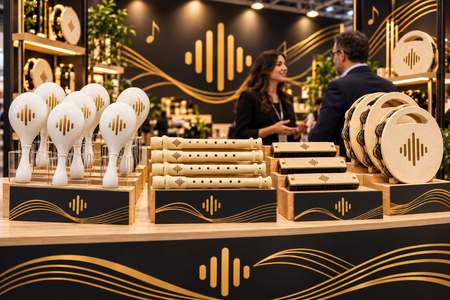
Music has always had the power to evoke emotions and bring people together. Custom Musical instruments build on that connection and can be used in many settings. Festivals, concerts and music events are obvious choices: these items engage the audience, help create an atmosphere or provide a small memento. In the recording and radio industries, they can promote new albums, accompany artist collaborations or serve as gifts for DJs and audio professionals. They are also suitable for music education: music schools, conservatories and cultural associations can hand them out at open days, beginner workshops and recitals, or make them available to students and teachers. Businesses can use music as an original theme for their merchandising. At trade fairs, during advertising campaigns or at product launches, instruments can be paired with Personalised USB flash drives containing playlists and audio tracks, or listening accessories such as Promotional Headphones and Branded Speakers. They also have a place in tourism, from hotels and holiday resorts to museums and tourist attractions. In hospitality they can support themed evenings and entertainment activities; at attractions, they can become souvenirs of the visit.
If you would like more detail or a practical checklist to help you choose the right Custom Musical instruments, download this guide.
Custom Musical instruments - FREQUENT QUESTIONS
It depends on the planned activity. Choose recorders or harmonicas if the aim is to learn simple, traditional melodies, for example in a music-school workshop. To involve a group straight away, choose maracas or tambourines, which require less initial practice. Percussion is therefore more intuitive for a corporate team activity, while wind instruments offer more teaching possibilities in an introductory course.
Consider the occasion and the target audience. Choose a mixer for someone who needs to combine audio sources or experiment with effects, for example as a prize at a workshop for aspiring DJs. A record player is more suitable for a vinyl enthusiast, perhaps as a gift for a collector or an artist at an album launch.
For conferences and trade fairs with many attendees, favour harmonicas, maracas and tambourines: they are generally affordable and versatile, and work both as souvenirs and as additions to welcome kits. Recorders are better when a specific musical activity is planned. Mixers and record players have a higher perceived value and are more suitable for competitions or special occasions.
For shows that encourage audience participation, maracas and tambourines help create shared rhythmic moments. At blues or folk concerts, harmonicas make a more genre-appropriate souvenir and are easy to carry. Consider mixers when setting up a DJ set or providing specific equipment to industry professionals.
For music museums, record shops or venues associated with an artist, a harmonica with a case is a classic, compact and recognisable choice. Recorders suit cultural experiences and workshops about traditional instruments, while maracas and tambourines evoke festivals and rhythmic celebrations. To make the souvenir distinctive, consider a discreet logo together with the venue name or event date.
It depends on the model. Harmonicas generally allow branding on the front, back or top, while tambourines can be customised in the centre. On recorders, the central section and, in some cases, the case can be used. On mixers, the area is usually small and located on the top of the device.
It depends on the effect you want and the characteristics of your logo. Choose pad printing for a straightforward design that retains your brand colours. If you prefer a more elegant, traditional, colourless finish, consider engraving. However, neither technique is guaranteed for every product: availability varies by model.
Yes, you can. Open the product page of the item you want, click “BUY SAMPLE” and complete the purchase. A sample lets you check the instrument’s dimensions, material and features in person.