


Choosing guide for Custom Stoppers
Custom stoppers are small but practical accessories for resealing bottles after opening and helping preserve their contents for longer. Available in different materials, shapes and sizes, they vary in appearance and function, from simple closures to mechanisms designed to improve drink preservation. Adding a logo or wording turns them into useful promotional items that help give businesses and events greater visibility.
Materials
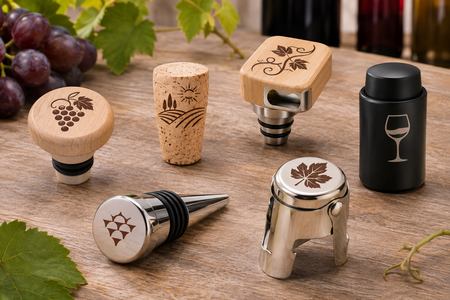
Cork has been used for centuries to make stoppers and other closures. Lightweight, natural and generally inexpensive, it fits into bottle necks and evokes traditional winemaking. Wood is valued for its warm appearance and distinctive grain, although it often forms only the outer section. Bamboo is mostly combined with other materials and has a clean, natural look. Stainless steel offers strength and corrosion resistance, while other metals are used for durable closures and locking mechanisms. Smooth metal surfaces also create a more modern, refined finish. Flexible, soft silicone is especially useful where the stopper contacts the bottle opening. Plastics such as ABS are valued for their light weight and rigidity.
Formats and sizes
Shape and size are two further distinguishing features of custom stoppers; both vary considerably depending on the model.
- Classic stoppers: simple, compact and traditionally shaped. They measure about 2–4 cm wide and no more than 4–5 cm high.
- Low-profile stoppers: slim models with notched edges, generally used on narrow-neck bottles. They measure just under 3 cm across and approximately 1 cm high.
- Airtight stoppers: designed to fit closely against the bottle opening, sometimes using a locking mechanism. They are generally 2.9–4 cm wide.
- Champagne and sparkling wine stoppers: feature a closure specifically designed for these bottles and a sturdier shape. They measure about 4 cm in diameter and 4–5.5 cm in height.
- Vacuum stoppers: usually taller so they can house an air-extraction mechanism, with approximate dimensions ranging from 3 × 9 to 4.6 × 7.2 cm.
- Multifunction stoppers: combine several accessories in one, often elongated, design. Dimensions depend on the functions included.
Some of the available functions
The main purpose of custom stoppers is to reseal an opened bottle and protect its contents between uses. Basic models do this without special mechanisms and can be reused. Other versions use more elaborate closures to help preserve beverages. Airtight stoppers use seals or close-fitting parts to reduce airflow and prevent leaks, while vacuum stoppers have a small pump that removes some of the air in the bottle, helping to slow wine oxidation. Twist-lock stoppers are secured by turning the cap to hold it more firmly in place. Flexible closures, generally made of silicone, use the material's elasticity to adapt to the bottle neck and provide a good seal. Some multifunction models also incorporate a bottle opener, combining two accessories in one.
Customisation
Printing techniques can reproduce wording and graphics on a product, making a simple promotional item recognisable and connected to a brand or event. However, not every process works with every stopper: the choice depends on the material, the design and the available print area. Pad printing is widely used for custom stoppers because it suits simple logos and works even on slightly curved or very small surfaces. The main alternative is engraving, which creates a precise, durable and elegant mark without added ink. Full-colour processes are less common: epoxy doming covers printed artwork with a clear, slightly raised layer, while digital transfer prints the design on a special carrier before transferring it onto the product.
Gift ideas and suggestions for use
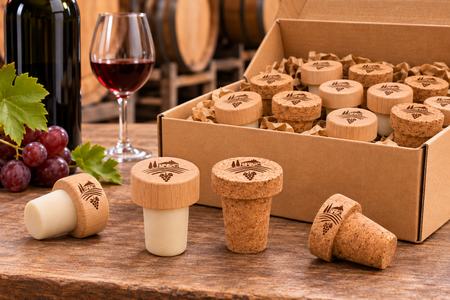
Custom stoppers are used in many professional settings, especially wine-related businesses, hospitality and catering. Besides their practical function, they can mark special occasions and remind people of an experience. Wineries often hand them out at tastings, guided tours and new-wine launches, or include them in gift boxes together with Printed Coasters and other Corporate branded Wine accessories. In restaurants, catering services and wine bars, they support the serving of wine by the glass and help preserve opened bottles. Hotels and farm stays can use them in their kitchens or add them to guest welcome kits. As practical, relatively low-cost gifts, they also suit corporate and trade-show distribution, especially at festive times or alongside useful items such as Personalised Placemats and Custom Cutlery.
If you would like further guidance or a practical checklist to help choose the most suitable custom stoppers, download this document.
Custom Stoppers - FREQUENT QUESTIONS
Start with where and how the stoppers will be used. Cork and wood suit promotional gifts for wineries and farm stays: they evoke winemaking traditions and look good with discreet branding. A wine shop selling wine accessories could choose multifunction models made from bamboo and metal. For frequent use by waiting staff, prioritise an easy-to-use closure, with silicone or ABS components.
It depends on the bottle they need to seal. Classic stoppers work well for still-wine bottles and gifts distributed at tastings and wine events. Low-profile silicone models take up less space and offer a simple, compact closure, provided they fit the bottle opening. Champagne and sparkling wine require special stoppers designed for carbonated drinks and to withstand internal pressure.
Choose according to the intended use. Airtight stoppers are practical for restaurants and catering services where bottles are repeatedly opened and closed. Vacuum models are especially useful for wine shops and wine bars serving still wine by the glass, particularly when a bottle is consumed over several days. Multifunction stoppers, often with a built-in bottle opener, suit tasting kits, gift boxes and promotional giveaways from wineries and wine producers.
It depends on the drink and how often the bottle is opened. For still wine served by the glass, especially if a bottle stays open between services, a vacuum stopper may be helpful. Sparkling wines require specific closures, while airtight and twist-lock stoppers are practical for bottles opened and resealed frequently.
Wineries can use classic cork or wooden models for tastings, or more elaborate stoppers for wine-club gifts and presentation boxes. Wine shops may prefer vacuum or sparkling wine stoppers, which pair naturally with bottles. Farm stays can choose simple compact models for gift baskets or airtight and vacuum stoppers for dining-room and restaurant service.
For trade fairs, events and large-scale giveaways, classic cork stoppers or compact silicone models are generally economical and easy to distribute. For tastings and food-and-wine events, wood has a more traditional appearance. For Christmas hampers and premium corporate gifts, consider vacuum or metal stoppers, especially models supplied in individual packaging or gift boxes.
It depends on the individual product. The most common positions are the top, front and back. Some models also allow branding on the shaft or lower section. To check the exact print area, dimensions and available techniques, see the Printing information section on each product page.
Yes, you can. Open the chosen product page, click BUY SAMPLE and complete your purchase. A trial sample is useful before a large order because it lets you check the dimensions, the look and feel of the materials and the stopper's closure in person.