



Guide to choosing Personalised Shopping Trolleys
Personalised Shopping Trolleys, like trolley coin keyrings, are practical items designed to make everyday shopping easier. Both types are available in different materials and models, each with its own shapes, sizes and features to suit particular needs. The available printing techniques also make it possible to add logos, wording and images, turning these everyday accessories into recognisable promotional products that convey a brand identity.
Materials
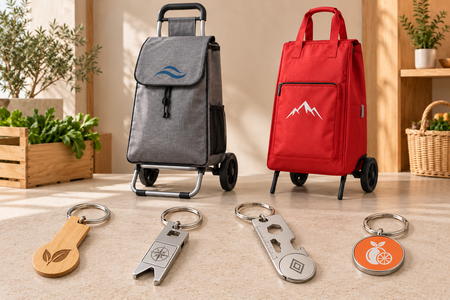
The materials used in these products vary from one item to another, affecting durability, weight and appearance. Synthetic options include polyester, both conventional and recycled. In either case, it is a hard-wearing fibre that is easy to clean. Metals are also widely used: stainless steel, whether conventional or recycled, is sturdy and corrosion-resistant; recycled aluminium is lightweight and durable, while zinc alloy is strong and versatile to work with. Enamelled iron has a coating that protects the surface and helps preserve its appearance over time. Less common is bamboo, a natural material appreciated for its distinctive grain and warm, understated look.
Models, formats and sizes
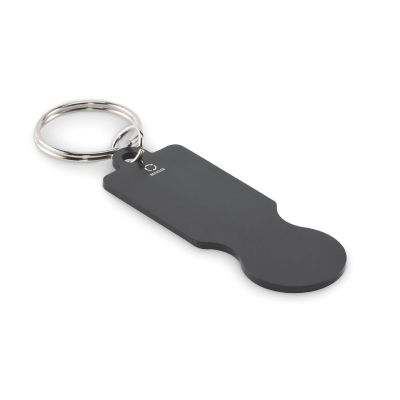
The first and most important distinction is between shopping trolleys and trolley coin keyrings: two types of accessories with different functions and characteristics. Shopping trolleys are wheeled bags designed to make carrying groceries easier. They are available in a foldable design, convenient for storage and transport when not in use; their dimensions generally do not exceed 20 cm in depth and reach up to 32 cm in width and 54 cm in length. Trolley coin keyrings, on the other hand, unlock supermarket shopping carts without the need to use your own coins. They are compact, generally measuring between 4 and 10 cm, and come in various designs: models with a built-in token, versions with a disc-shaped token, and multifunction keyrings with added tools such as bottle openers, rulers or hex keys.
Closures and other details
Personalised shopping trolleys can be folded away to reduce the space they take up when not in use. Accessory pockets have zip closures for keeping small items separate from the main compartment. Other features include reinforced handles to make lifting and carrying easier and metal supports that hold the frame together and improve stability. Reinforced wheels facilitate movement even when the trolley is fully loaded, while rubber protective feet shield contact points from direct contact with the ground. Trolley tokens, however, have no closures and almost all feature a keyring or attachment mechanism. This makes them more versatile, allowing them to be kept with keys or attached to bags and backpacks.
Printing methods
Personalisation is the process of reproducing different kinds of artwork on promotional products, making them unique and recognisable. Not every method suits every item: the choice depends on the material, the features of the logo and the available print area. For personalised shopping trolleys, the most common methods are screen printing, economical for large quantities and especially suited to simple logos with a few solid colours, and transfer printing, applied to fabric with heat and capable of reproducing more elaborate designs. Digital textile transfer is another option for detailed images, gradients and full-colour artwork. For trolley coin keyrings, engraving and pad printing are the main methods. Engraving marks the surface directly without ink, producing an elegant, precise and long-lasting result. Pad printing transfers colour using a pad and works on small or slightly curved surfaces; like screen printing, it is suited to relatively simple artwork.
Gift ideas and suggestions for use
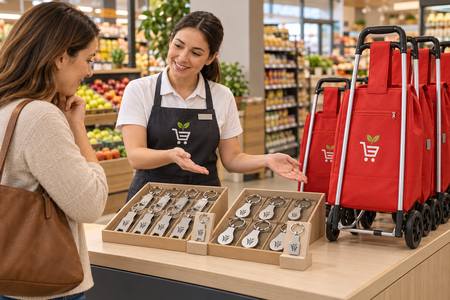
Although very different, personalised shopping trolleys and trolley coin keyrings share the same setting: everyday shopping. The former were originally designed to make carrying groceries easier, while the latter unlock most shopping carts provided by retailers. This is why both are widely used in the grocery retail sector. Supermarkets, discount stores, mini-markets and food shops can give them away for store openings, promotional campaigns, loyalty programmes and points-based rewards. Food producers, local growers and market organisers can also offer them at trade fairs, food events and initiatives celebrating local products, especially alongside other food- and kitchen-related items such as Corporate branded Aprons, Personalised Placemats and Custom Wine & bar accessories. These accessories are also useful to local authorities, cooperatives and associations: shopping trolleys are particularly appreciated by older people and anyone who finds carrying heavy loads difficult. Using them in initiatives aimed at these groups provides practical, meaningful assistance to those who need it.
If you need further information or a practical checklist to help you choose the most suitable Personalised Shopping Trolleys, download this document.
Personalised Shopping Trolleys - FREQUENT QUESTIONS
It depends on the features you need. Stainless steel looks understated and is quite robust, while recycled aluminium is a good choice if you prefer a lightweight item. Zinc alloy highlights metallic finishes, whereas enamel-effect iron adds coloured details. Bamboo suits branding with a natural aesthetic. For a giveaway distributed every day in-store, prioritise lightness and durability; for a more distinctive gift, focus on appearance and how the logo will look.
Choose a trolley coin keyring if you need to distribute large numbers of compact gifts, for example at a supermarket opening: it is easy to hand out and keep close at hand. A foldable shopping trolley is more suitable when you want to offer a higher-value gift and practical help with carrying groceries, such as a loyalty points reward. Consider your budget, the number of recipients and the product’s actual usefulness.
Yes, but it depends on the materials used. Reusable trolleys in recycled polyester and keyrings in recycled metals can support campaigns focused on reuse and resource conservation. To make your message credible, choose items that recipients will genuinely use and specify exactly which components are made from recycled or natural materials.
The choice depends on the audience, the number of gifts and the value you want the initiative to convey. For busy trade fairs and store openings, trolley coin keyrings are easier to carry and distribute; multifunction versions are preferable if you want to add extra utility. For competitions and loyalty points schemes, a foldable shopping trolley can become a more substantial reward.
It depends on the specific model. Trolley coin keyrings often allow printing on the front, back and token itself. On standard shopping trolleys, the logo may be positioned on the upper or lower part. Before buying, check the available positions in the “Printing info” section.
It depends on the artwork. For a single-colour logo and a large order, screen printing is generally economical. If the logo has several colours, consider transfer printing; for images, gradients or detailed illustrations, digital textile transfer offers more flexibility. However, the available methods vary by product, so always check that your preferred method is offered before ordering.
Choose engraving for a discreet, precise and wear-resistant finish, for example on a corporate gift with a simple emblem. Pad printing is preferable when you need to retain the colours of your branding, such as on tokens given away in a supermarket promotion. Always confirm that the chosen printing method is available on the product.
Yes, this option is available in most cases. Open the relevant product page, click “BUY SAMPLE” and complete the purchase. A sample is very useful for checking the product’s actual features and dimensions.