


Guide to choosing Custom Laptop cases
Custom Laptop cases protect laptops against scratches, knocks and everyday wear during travel and commuting. Different styles and sizes are available to suit laptop dimensions and the features required. Each material affects protection, weight and appearance. Printing techniques also allow company logos and artwork to be added, making these cases suitable both as gifts and as company-issued equipment.
Models and accessories
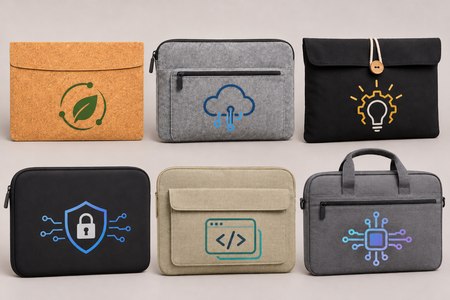
The range of custom laptop cases varies mainly in construction, carrying method and the way the space is organised. The most common option is the envelope-style sleeve: slim and compact, it fits around a laptop and slips easily into a backpack. There are also organiser bags designed to store and carry small tech essentials, such as cables, Custom Phone chargers, Personalised Power banks and Personalised Mouse. Additional features can make a case more practical and versatile. Padding and linings help protect the computer from impacts and rubbing, while handles make carrying easier. Zips, buttons, magnetic fastenings, hook-and-loop closures and elastic straps provide different ways to open and close a case. Internal and external pockets, dividers and elastic loops separate the laptop from other items. Some models even include a laptop stand or a strap for attaching the case to a trolley.
Materials
The most widely used material for custom laptop cases is RPET, a polyester made from recycled PET plastic, valued for its low weight and durability. It can be made into a compact fabric that stands up to everyday use or into felt, which feels softer and has a distinctive matt finish. Cotton is another common choice, including recycled cotton and heavier weaves such as canvas. Its simple, natural appearance works well for soft, flexible sleeves. Less common options include cork, recognisable by its natural, irregular texture, and faux leather, which offers a smooth, more formal look. Recycled leather provides a leather-like finish while making use of previously processed materials.
Sizes and dimensions
Laptop cases generally follow the shape of the device: they are rectangular, wider than they are tall, with square or rounded corners depending on the model. Although dimensions are listed in centimetres, laptop sizes are usually described in inches, referring to the screen diagonal. This gives an initial indication of which device may fit a particular case. The range covers 13 to 16 inches, with 14-inch and 15–15.6-inch models particularly common for work and study. The outer case is naturally larger than the screen diagonal. For example, 14 inches is just over 35 cm, while compatible cases can measure up to 39 cm wide. The extra room helps the laptop slide in and out more easily.
Printing techniques
Custom Laptop cases can carry company logos, lettering and images, linking them visually to a brand or event. Not every printing method is available on every model: suitability depends on the material, artwork and printable area. Transfer printing is a common choice for flat surfaces and offers good resistance to wear and washing. Screen printing is also widely used; it is versatile and particularly suitable for simple logos with a few solid colours. For detailed graphics and gradients, consider digital transfer printing, which reproduces full-colour artwork. Embroidery is a different option: coloured threads form the design directly on the fabric, creating a subtly raised, durable finish. However, embroidery is less suitable for very small details and complex gradients.
Gift ideas and suggested uses
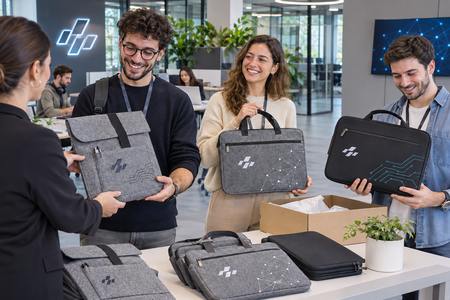
Protecting and carrying a laptop is a daily need in many professions, especially for people who work on the move. Custom laptop cases can therefore be issued as work equipment or offered as company gifts, with the model selected to suit the recipient's needs. In IT and technology companies, they can accompany laptops issued to new employees and are equally useful for staff who divide their time between home and office. The same applies to professional practices and consultancies, where travelling between offices and clients is frequent. Laptop cases also make valuable gifts at events and during corporate distributions, particularly when combined with Personalised Backpacks and Personalised Water bottles & Sport bottles. Together they create a practical, useful kit for conferences, congresses and business trips. Universities and training centres can likewise provide them to students and lecturers attending postgraduate courses, professional training and advanced programmes.
If you need more detailed guidance or a practical checklist to help you choose the most suitable custom laptop cases, download this practical guide.
Custom Laptop cases - FREQUENT QUESTIONS
It depends on the intended use. A laptop case holds the computer; an organiser bag keeps chargers, power banks, a mouse and other accessories tidy, but does not replace a laptop sleeve. For an onboarding kit containing a laptop and peripherals, both can be useful. If a consultancy is distributing only a travel accessories kit, an organiser bag may be enough.
For people carrying a laptop between offices, client visits and meeting rooms, padding, a zip closure and an outer pocket for documents or the charger are useful. Handles help when carrying the laptop without a backpack, while a trolley strap is handy on frequent trips. A simple sleeve can be sufficient if the laptop rarely leaves the office. Always check the dimensions and available printing methods before ordering.
Collecting the exact model and dimensions of every recipient’s laptop can be difficult. If this is not possible, choose common, mid-range sizes. The 14-inch and 15–15.6-inch formats are widespread and fit many laptop models. Consider an organiser bag if you want to avoid giving someone a case that will not fit their device.
For university courses and postgraduate programmes, choose lightweight models that slip into a backpack and have an easy-to-use closure. At a congress, where speakers and attendees move between rooms and hotels, padded versions with handles or pockets are useful. If a case accompanies a laptop supplied by the organiser, match it to that laptop’s dimensions: practical use matters more than the finish.
Start with how they will be used. For regular commuting and resistance to everyday wear, consider compact RPET fabric and check for padding. RPET felt and cotton work well for light cases in course or event kits; faux leather and recycled leather look more formal and suit gifts for clients and partners. Cork has a distinctive natural finish and works particularly well for events focused on sustainability.
It depends on the model. The most common areas are the front and back, at the top or bottom. Some cases also allow printing on pockets, flaps or areas near a zip. A large graphic needs an unobstructed panel, whereas a small logo may look better in a discreet position. Always check the exact measurements and positions under Printing information.
Yes, in most cases you can. Open the product page, select BUY A SAMPLE and complete the order. A sample allows you to examine the actual size, colour and features of your chosen custom laptop case.
Start with contrast: a white or light logo stands out on dark surfaces, while dark graphics read more clearly on lighter backgrounds. For long-term company equipment, black, grey and other neutrals are easy to coordinate. For an event, you might choose an available shade close to your visual identity. Check the product’s colour options and review the artwork proof: the result also depends on the printing method and material texture.