
Choosing guide for personalised business cards
Personalised business cards are among the most common communication tools in the world of work. Their usefulness extends to every sector and to companies and self-employed professionals who want to leave a point of reference for their customer or for someone who may one day become one. The different shapes, combined with the available paper types and, of course, printing techniques, allow almost unlimited personalisation in every respect. There are also many possible use ideas: personalised business cards can be handed out at a trade fair or congress, but also in a restaurant, whether it is a trattoria or a lounge bar by the sea. When the customer finds the card again, they will immediately identify that place or person and know how to get back in touch.
Available formats
The available formats and sizes cover what are normally the main requirements for personalised business cards: pocketability, compact dimensions and a perfect match with personalised business card holders. Their shape is mainly square or rectangular, depending on the model chosen. Sizes also vary according to the product, but as a general indication the width is almost never greater than 95 millimetres. The length, on the other hand, rarely exceeds 60 millimetres, unless the card is square. For precise and detailed information on each product, simply check the relevant product page.
Paper: the main material for personalised business cards
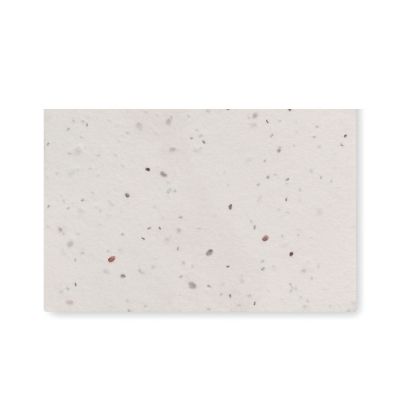
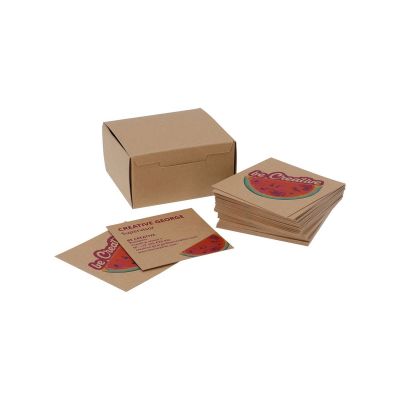
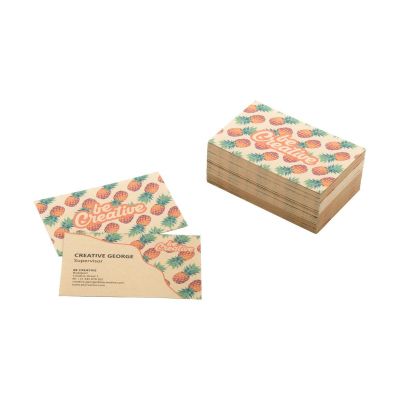
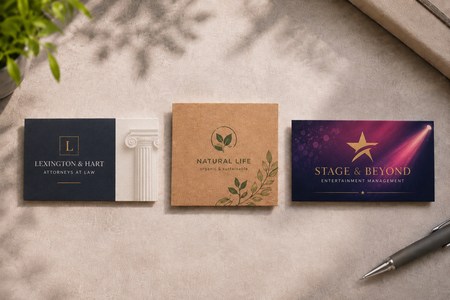
Paper is without doubt the most common and practical material for personalised business cards. It is available in different types, allowing a company to choose the product it considers most suitable for its needs. One particularly distinctive option is wildflower seed paper, which can be planted after use and has a very natural appearance. It is ideal for agritourism businesses, nurseries and gardening companies. More common options are white paper and kraft paper, both matte and therefore less reflective, with a more understated appearance. Kraft paper, in particular, is characterised by its natural brown/beige colour and gives a handcrafted feel, while white paper is more neutral and works well in professional settings. If a company wants particularly resistant personalised business cards, one of the best options is certainly tear-resistant card stock, designed specifically to withstand tears and folds.
Possible covers
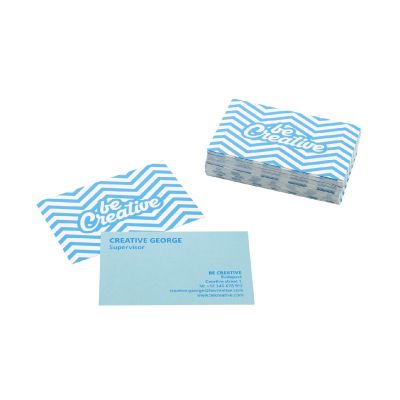
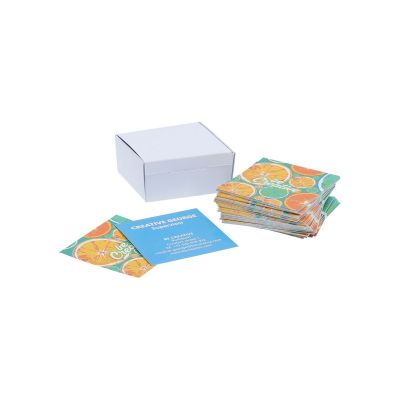
The part that inevitably stands out most on personalised business cards is the cover. By personalising it, the company or self-employed professional chooses how they want to be remembered by the customer. The first impression is often the one that remains longest in people’s memory and, thanks to the various printing techniques available, it is possible to choose the style that best suits the occasion. A law firm will certainly want a sober and professional look, while an entertainment professional such as a magician or comedian will want to convey cheerfulness and sociability. All this is possible because, once the desired product has been selected, the personalisation is in the customer’s hands.
The most suitable printing techniques
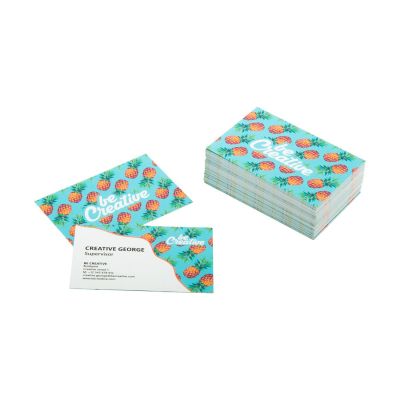
Of all the available printing techniques, the one that probably best suits personalised business cards is digital printing. As a modern and highly versatile technique, it allows high-quality results while also being very quick to produce. Another typical feature of this process is the possibility of printing in four colours. This leaves plenty of room for creativity, with colours and shades that can appear vivid and even. Two other possible techniques are digital transfer, which can also provide an almost photographic result, and pad printing, which is versatile and economical.
Some use ideas for personalised business cards
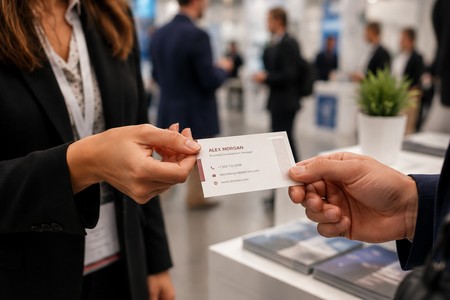
As you can also read in this Forbes article, there is no real limit to the possible uses of personalised business cards. Thanks to their versatility, they are useful in many situations. Receiving one at a congress, trade fair or promotional event is very common, both for a visitor and for an employee of the exhibiting company. They are almost essential for people such as estate agents and sales managers, who need customers to remember them and know how to contact them when needed. Staying with self-employed professionals, personalised business cards are effective and, above all, necessary for lawyers, engineers, accountants and architects too. Promoting yourself and your practice by leaving a card with customers is an excellent way to become part of their everyday life and convey availability. Another possible combination is for companies to welcome new employees with a kit containing personalised business cards, personalised pens and personalised USB flash drives. This item has also long been used by hotels, bars and restaurants, especially to encourage customers to promote the venue indirectly through word of mouth.
If you need further information or want a practical checklist to help you choose the personalised business cards that suit you best, download this document.
Personalised Business cards - FREQUENT QUESTIONS
Each card, depending on its size and the selected printing technique, has a corresponding print area available. Information of this kind is specified precisely on the individual product pages. If you cannot find what you are looking for, contact us.
Yes, their dimensions are specifically designed so they can be stored both in promotional wallets and in standard wallets. One of their main characteristics is that they are pocket-sized, an almost essential requirement for this type of product.
They are generally rigid. Their paper-based composition tends not to allow folding without the product then being damaged or permanently altered. For exact and detailed information, however, it is always advisable to check the product pages or contact us.
Yes, most of them, being made from fully recyclable paper, fall within the range of eco-friendly products. You can also choose cards made from kraft paper or seed paper, to immediately convey an impression of environmental awareness to the person receiving the card.
Each product has its own specifications, but on most personalised business cards it is possible to print text and logos on both the front and the back.
Printing costs are generally not included but, with personalised business cards, it may happen, depending on the product in question, that digital printing is included. For exact and detailed information, always check the product pages or contact us.
Yes, absolutely. To ensure that the QR Code works correctly and can be read without problems by all smartphones, there must be a strong colour contrast between the code and the background. The code should always be very dark (such as black, navy blue or anthracite grey) and printed on a very light background. It is also advisable to avoid reversing the colours (light code on a dark background), as many readers may be unable to decode it.
It depends greatly on the message you want to convey, but the information most commonly included on business cards is: the full name of the person or company, physical address and email address, telephone contact details and, if useful, a QR Code.