

Choosing guide for Personalised Notebooks
Personalised notebooks are an essential tool for anyone who needs to take notes, draw and organise ideas, projects and information. Their use remains widespread even in the digital age thanks to their versatility and, above all, because they offer a quick and practical way to meet professional, creative and personal needs. Formats, materials, covers and other details can be selected according to individual requirements, while personalisation helps enhance the brand of companies and professionals.
Available formats
For stationery products such as personalised notebooks, format determines the dimensions, practicality and space available for writing. Most items show the exact width, height and thickness. To make it easier to compare different models, however, standard A and B series formats are generally used as a reference.
- A4 format: spacious and convenient for both extensive notes and drawing. It is mainly found in notebooks and is ideal for workshops and university.
- A5 format: the most common and versatile size. It is available across different notebook styles and offers a good writing surface while remaining easy to carry. It is suitable for offices, meetings and training courses.
- A6 format: compact and easy to carry. Together with A5, it is one of the most widespread sizes and is particularly suitable for quick notes and for commercial and hospitality settings.
- A7 format: a mini, lightweight and very compact format. It is especially convenient for short notes and use on the move and is found almost exclusively in pocket notebooks.
- B6 and B7 formats: both are compact and used for notebooks. B6 sits between the smaller formats and A5, while B7 keeps bulk to a minimum and is ideal for pocket use.
Paper and other materials
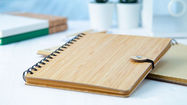
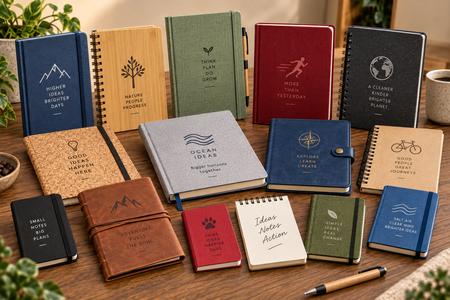
Paper and cardboard are the main materials used in personalised notebooks, but there are many variations. Traditional paper and recycled paper, usually white or cream/ivory, are naturally the most common; they are suitable for both everyday and occasional use and are available ruled, squared, dotted or blank. The same applies to cardboard, which is available in both traditional versions and alternatives made from recycled materials. Kraft paper has a more natural colour and appearance and is mainly used for informal products. There are also particularly sustainable papers made from alternative fibres or recovered materials, including grass paper, seed paper (which can be planted after use) and paper made from waste materials such as cotton, sugar cane and milk cartons. Specific processes can also create highly distinctive results: stone paper offers greater resistance to water and tearing; watercolour paper is designed for drawing, while acid-free paper is made to avoid or limit acidic substances that can contribute over time to yellowing, brittleness and deterioration. These paper and cardboard options are not the only materials used in personalised notebooks. Looking at covers and other details reveals a wide range of materials that define the appearance and functionality of the product. Synthetic fibres such as PU leather, polyester, PP and other plastics add resistance and improve durability, while RPET and recycled felt make use of waste materials. Natural elements such as cork and bamboo are very common, especially in Personalised Eco notebooks, and are appreciated for both their visual and tactile qualities.
Covers and other details
The cover is probably the most visible part of a personalised notebook. It defines the look and character of the product while also affecting durability and practicality. A hard cover is the most common option, providing stability while writing and protecting the pages. Flexible covers are also widely used because they are lighter, thinner and easier to carry. A semi-rigid cover offers a useful compromise between protection and flexibility, retaining some structure while remaining fairly light. Another important aspect is the binding, the system used to join and secure the pages. Traditional binding is fairly common and includes sewn, thread-bound or book-style solutions, while Personalised Spiral notebooks use rings or spirals to allow full opening and greater freedom of use. For added protection, some models include specific closure systems: in Personalised Elastic band notebooks, the elastic keeps the pages together and can run vertically or, less commonly, horizontally; it is often colour-coordinated with the cover. A less common alternative is the magnetic closure, which is elegant and immediate. Many products also include a ribbon bookmark to quickly find the last page used. Models in the Personalised Notebooks with pen category include a fountain pen and sometimes a loop or band to keep it close at hand. Internal or external pockets, document sections, smartphone stands and additional components such as charging cables and sticky notes can further improve organisation, practicality and functionality.
Print methods
Personalisation is what makes promotional items unique and recognisable, but not every available print method can be applied to every product. The choice depends on several factors, especially the selected material, the characteristics of your logo and the available print area. Screen printing and pad printing are widely used for personalised notebooks. They can be applied to many surfaces and are ideal for simple logos and for anyone looking for an economical and durable technique; however, they are limited to four solid colours. Digital methods offer much greater creative freedom. Transfer printing can reproduce detailed, vivid graphics that resist wear, but it is limited to a maximum of eight solid colours. UV LED printing and digital transfer, by contrast, have no such colour limitation: both can print in full colour and reproduce complex graphics and gradients with high quality. These methods, however, are not always the most economical. If you want a more elegant result with a pleasant relief effect, you can choose engraving or debossing when available. Engraving creates depth and is durable, precise and suitable for reproducing detailed text and graphics, provided they are sufficiently linear. Debossing presses the logo directly into the material. Although these methods do without colour, they enhance relief and three-dimensional effects.
Gift ideas and usage suggestions
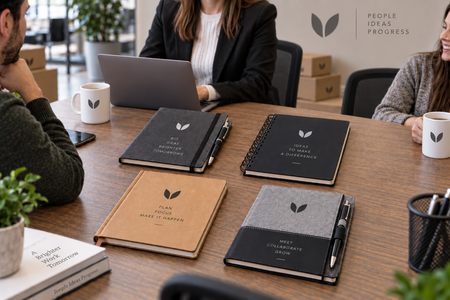
Personalised notebooks are designed to help us write, draw and organise ideas and plans. Handwriting has accompanied people throughout history and has long offered benefits for learning, concentration and memory. These qualities have preserved the relevance of such products over time and explain why they are still widely used in many settings. In companies, offices and professional practices, they are used alongside Personalised Diaries and Personalized Notepads, both to organise work and to record ideas, information and decisions during meetings. In schools, universities and training environments, students and teachers use them for notes and exercises, and they can also be supplied as teaching materials. Hotels, conference venues and the hospitality sector can provide them to guests and place them in shared areas, while at trade fairs and events they can be distributed on a large scale together with Personalised Pens and Personalised Pencils. In this way, the brand can increase its visibility while providing customers with useful, versatile products.
If you need further detail or a practical checklist to help you choose the personalised notebooks that suit you, download this document.
Personalised Notebooks - FREQUENT QUESTIONS
The choice depends on the intended use and the features you are looking for. Personalised Notebooks are generally more compact and designed for frequent note-taking; they support mobility and are ideal in dynamic settings. Larger notebook models, on the other hand, are suitable for more extensive notes, developing projects, studying and organising information over the long term. Before buying, also consider the format, number of pages and binding.
The most suitable formats for events and large-scale distribution are A5 and A6. A5 offers a good balance between practicality and writing space and is highly versatile, while A6 is more compact and easier to distribute. Larger formats, such as A4, are particularly suitable when more space for notes is required, for example during training sessions and workshops. Consider smaller formats such as A7, B6 and B7 if you want to offer a practical, lightweight product that is easy to carry at all times.
It depends on the duration of the event and how frequently the notebook will be used. Thinner models may be enough for short events; for training, recurring meetings or daily use, it is better to increase the number of sheets. Check the product page carefully, however: one sheet corresponds to two pages; therefore, a notebook described as having 80 sheets normally provides 160 usable sides.
Yes, but the details make the difference. Consider a well-finished cover, good paper quality, sturdy binding and accessories such as a bookmark, pen holder, pockets or smartphone stand. Personalisation is important too: engraving and debossing can create a more discreet and refined result. For important clients, anniversaries and corporate gifts, also consider materials and finishes that match the brand positioning.
Choose according to the intended use. The elastic keeps the notebook closed during transport; spirals and rings, on the other hand, allow the pages to turn fully and make writing comfortable even when space is limited. Remember that these are two different features and they can also be combined in the same model. For a more classic look, consider traditional or sewn bindings; for a more elegant and immediate opening, some models are also available with a magnetic closure.
It depends on the context of use. A hard cover is suitable for corporate gifts, important clients, meetings and premium supplies. A flexible cover is practical for trade fairs, conferences, courses and large-scale distribution, where light weight and easy transport matter. A semi-rigid cover is a good compromise for welcome kits, onboarding and internal supplies because it maintains a good quality perception without being too structured. Before buying, also consider formats, closures, additional details and materials.
For a supply that will be used every day, choose practical and durable models, preferably with accessories that improve practicality and functionality, such as a pen holder, elastic closure, bookmark or ring binding. A5 is particularly versatile, while A6 or pocket formats are suitable if the office kit needs to be compact. An included pen also makes the set immediately ready to use.
Yes, this option is available for most personalised notebooks. Simply open the product page you want, click “BUY SAMPLE” and complete the purchase. A sample is very useful if you are planning a large order because it lets you evaluate the dimensions, material and functionality in person.
It depends on the model. The most common positions are the front and back of the cover; some items also allow personalisation of the entire surface, inside cover, internal pages or specific areas. In sets, the pen and packaging may also be customisable. Each position has its own dimensions and print methods, shown in the “Printing information” section of the relevant product page.
It depends on the characteristics of your logo and the result you want to achieve. Choose digital printing for multicolour logos, gradients and detailed graphics. Laser engraving is suitable when you prefer a permanent result without colour; it is particularly effective and distinctive on materials such as wood, bamboo or cork. Debossing creates a discreet recessed effect, ideal for an elegant and tactile result.